
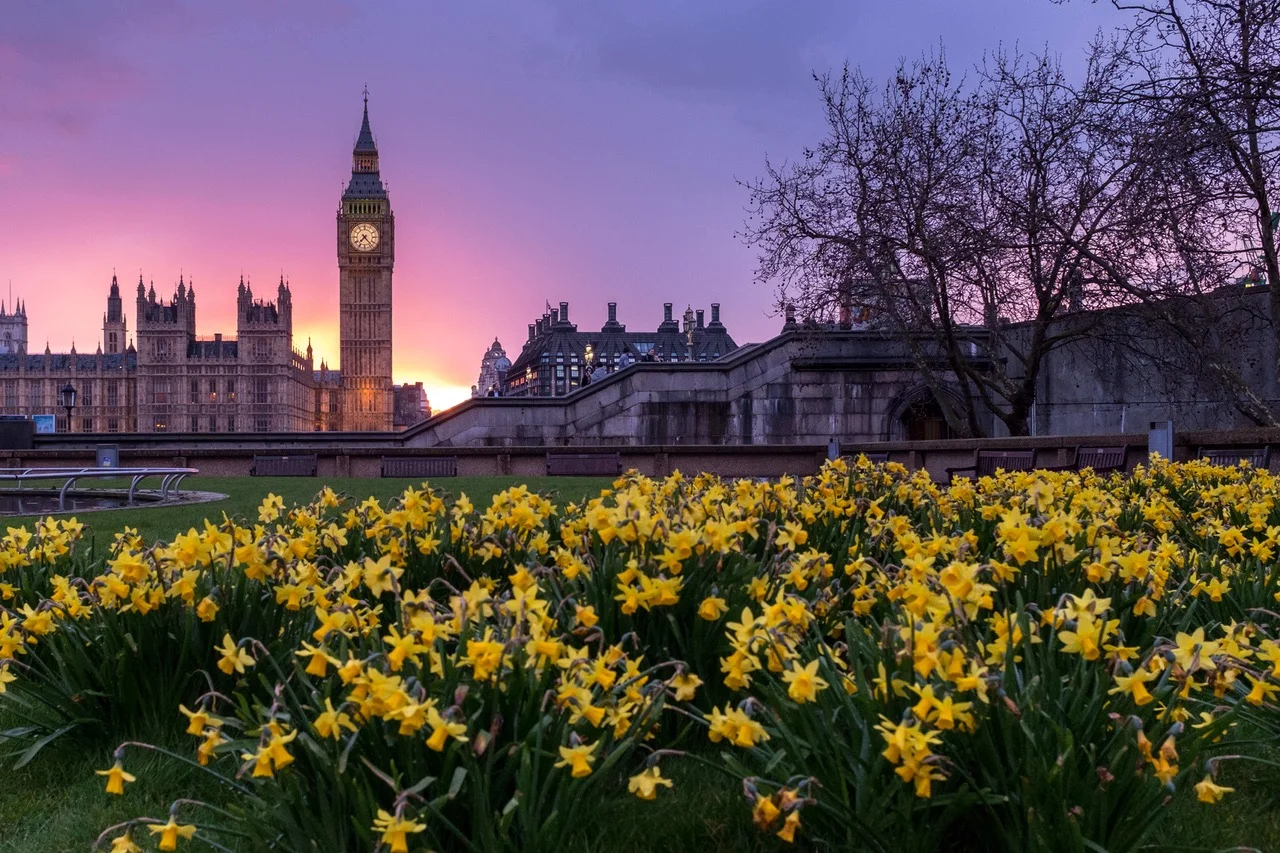
Today I came across an interesting fact about London... and that inspired me to look into some other interesting facts about London.
See the list below.
- The world's first traffic light was erected outside the House of Commons in 1868. It blew up the following year, injuring the policeman who was operating it.
- The tomb of Elizabethan poet Edmund Spenser in Westminster Abbey is said to contain unpublished works by his contemporaries - including Shakespeare - who threw manuscripts into his grave to honour his genius.
- Cars are required by law to travel on the right-hand side of the road in Savoy Court - this was originally decreed by Parliament in 1902 so that theatregoers could decamp from their carriages directly into the Savoy Theatre.
- One, London, is the postal address of Apsley House, the Duke of Wellington's former residence on Hyde Park Corner.
- Arsenal is the only football club to have its own, eponymous Tube station, even though London's Arsenal was based in Woolwich.
- St Thomas' Hospital used to have seven buildings, one for each day of the week, supposedly so that staff knew on which day patients had been admitted. Only two of the buildings remain.
- Signs on Albert Bridge order troops to break step while marching over it, to avoid damaging the structure with resonating vibrations.
- Before the 17ft statue of Nelson was erected on top of the Trafalgar Square column in 1842, 14 members of the memorial committee who had commissioned the work held a dinner party on the 170ft-high plinth.
- The exact centre of London is marked by a plaque in the Church of St Martin's-in-the-Fields overlooking Trafalgar Square.
- Brixton Market was the first electrified market in the country and stands, as a result, on Electric Avenue.
- Dr Samuel Johnson once owned 17 properties in London, only one of which survives - Dr Johnson's Memorial House in Gough Square, which contains a brick from the Great Wall of China, donated to the museum in 1822.
- The Fleet River - one of the capital's many buried waterways - still runs under the cellars of the Cheshire Cheese pub on Fleet Street.
- East London is the most popular film location in the city, playing host to everything from Oliver! to A Clockwork Orange and Full Metal Jacket. The naval buildings of Greenwich stood in for Washington in Patriot Games.
- The Monument to the Great Fire of London was also intended to be used as a fixed telescope to study the motion of a single star by Robert Hooke, who designed the structure with Sir Christopher Wren.
- Only six people died in the Great Fire of London, but seven people died by falling or jumping from the Monument to it before a safety rail was built.
- Postman's Park, behind Bart's hospital, is one of London's great hidden contemplative spots. It is full of memorials to "ordinary people" who committed heroic acts.
- The tiered design of St Bride's Church in Fleet Street is believed to have been the inspiration for the tiered wedding cake.
- The nursery rhyme Pop Goes the Weasel refers to the act of pawning one's suit after spending all one's cash in the pubs of Clerkenwell.
- The circular church of Nôtre Dame de Paris in Leicester Place off Leicester Square has a crucifixion mural, including a self-portrait, painted by the French artist Jean Cocteau in 1960.
- The Piccadilly Circus statue known as Eros is actually intended to depict the Angel of Christian Charity and is part of a memorial to the Seventh Earl of Shaftesbury. Its stance, aiming an arrow up Shaftesbury Avenue, is thought to be a coarse visual pun.
- Pubs in Smithfield, such as the Fox and Anchor, and in Borough, such as the Market Porter, are licensed to serve alcohol with breakfast from 7am to fit in with the hours worked by market porters.
- The only true home shared by all four Beatles was a flat at 57 Green Street near Hyde Park, where they lived in the autumn of 1963.
- The gravestone of the famous Elizabethan actor Richard Burbage in the graveyard of St Leonard's, Shoreditch, reads simply "Exit Burbage". The church's burial register also records the death in 1588 of Thomas Cam, aged
- London was the first city to reach a population of more than one million, in 1811. It remained the largest city in the world until it was overtaken by Tokyo in 1957.
- The first performance of a Punch and Judy show at Covent Garden was recorded in Samuel Pepys's diary entry for 9 May 1662, and it is believed a similar puppet show has been seen there every year since.
- The only London theatre not to close during the war was the Windmill in Soho, which then offered a variety show mixing comedy acts with semi-nude female tableaux. It is now a table-dancing club.
- The Dome, the focus of the Millennium celebrations, is the largest structure of its kind in the world - big enough to house the Great Pyramid of Giza or the Statue of Liberty.
- Elephant and Castle derives its name from a craftsmen's guild, whose sign featured an elephant in reference to the ivory handles of the knives they made.
- Mayfair is named after a fair that used to be held in the area every May; Piccadilly after a kind of stiff collar made by a tailor who lived in the area in the 17th century; and Covent Garden was originally the market garden for the Convent of Westminster Abbey.
- In 1926, John Logie Baird demonstrated how television would work in what is now Bar Italia in Frith Street, Soho.
- London's smallest house is three-and-a-half-feet wide, and forms part of the Tyburn Convent in Hyde Park Place, where 20 nuns live.
- The Houses of Parliament has 1,000 rooms, 100 staircases, 11 courtyards, eight bars and six restaurants - none of them open to the public. The Palace of Westminster was sited by the river so it could not be totally surrounded by a mob.
- The site of Tyburn Tree, London's infamous public gallows - where an estimated 50,000 people were hanged - is now a traffic island at the junction of Marble Arch and Edgware Road.
- The architect of the Oxo Tower, forbidden from including an electrified advertising hoarding in the building, instead incorporated the company's name in the windows on all four sides.
- It is illegal in London to have sex on a parked motorcycle, beat a carpet in a public park, or impersonate a Chelsea pensioner - the latter offence is still theoretically punishable by death.
- Marble Arch was designed by John Nash in 1828 as the entrance to Buckingham Palace but was moved to Hyde Park when Queen Victoria expanded the palace. It contains a tiny office once used as a police station.
- There is a 19th century time capsule under the base of Cleopatra's Needle - the 68ft, 3,450-year-old obelisk on the Embankment - containing a set of British currency, a railway guide, a Bible, and 12 portraits of "the prettiest English ladies".
- Jarvis Cocker, the singer of the pop band Pulp, wrote a song called 59 Lyndhurst Grove after being thrown out of a party at that address in Peckham.
- The Houses of Parliament are officially known as the Palace of Westminster and it is the largest palace in the country.
- The Palace of Westminster has eight bars (where prices are kept cheap, thanks to the taxpayer), six restaurants, 1,000 rooms, 100 staircases, 11 courtyards, a hair salon, and rifle shooting range.
- It is illegal to die in the Palace of Westminster.
- Many playwrights and poets are buried at Westminster Abbey. The tomb of Elizabethan poet Edmund Spenser is there and, according to historian Edward Camden, contains unpublished works by his admirers — possibly including Shakespeare — who threw poems into his grave as a tribute.
- Big Ben is the bell, not the clock tower. Its chime is in the key of E.
- Cock Lane, near Holborn Viaduct, didn't get its name due to any association with poultry, but because it was the only street to be licensed for prostitution in medieval times. (This makes me wonder about the pond on Clapham Common…)
- Other unusual street names in London include Ha Ha Road in Greenwich, Hooker's Road in Walthamstow, Quaggy Walk in Blackheath, and Cyclops Mews and Uamvar Street in Limehouse.
- The Beatles played their last gig on the roof of Apple Corps at 3 Saville Row. It's now an Abercrombie & Fitch store.
- Jimi Hendrix lived at 23 Brook Street, which has been used as offices but is now being converted into a museum.
- Two doors down at 25 Brook Street is where the composer Handel lived from 1723 to his death in 1759, and that flat has already been turned into a museum.
- London is full of pubs associated with artists, writers, and poets. The Fitzroy Tavern on Charlotte Street was famous for hosting Dylan Thomas, George Orwell.
- Only one house where Charles Dickens lives still stands, at 48 Doughty Street, which is now a museum. He lived there from 1837 and 1839, and it's where he wrote Oliver Twist and The Pickwick Papers.
- Manette Street in Soho is named after the character from Dickens' A Tale of Two Cities. Dickens describes the street having a golden arm — the one above Goldbeaters' House was built in modern times to match his description.
- Great Ormond Street Hospital, off Russell Square, owns the copyright to Peter Pan and receives royalties from all associated works and performances. Author J.M. Barrie — who had no children himself — gifted the rights to the hospital in 1929. (This is a great reason to buy the book or film for your children)
- The Coach and Horses Pub in Greek St, Soho, has been the haunt of many artists, journalists, barflies, and actors, including Tom Baker and John Hurt. Long-standing and famously irritable landlord Norman Balon called his memoirs You're Barred You Bastards: Memoirs of a Soho Publican.
- Ronnie Scott's Jazz Club on Frith Street was the site of Jimi Hendrix's last public performance in 1970.
- Trident Studios, off Wardour Street, is where The Beatles made much of the White Album and David Bowie recorded Ziggy Stardust.
- The reading room at the British Museum is where Karl Marx wrote Das Kapital in between bouts of getting very drunk and asking Friedrich Engels to lend him more money.
- Street names that sadly no longer exist include Shiteburn Lane, Pissing Alley, and more than one Gropecunt Lane, which as the name might suggest, was associated with prostitution.
- Until 1994 there were no "Road"s in the City of London, and now there's only one, Goswell Road, which became part of the Square Mile in 1994 after boundary changes. There are plenty of Lanes, Streets, and Ways, but public paths weren't generally referred to as roads until the 16th century.
- Before the statue of Nelson was placed on top of the 17-foot-tall column in Trafalgar Square in 1842, 14 stonemasons had dinner at the top.
- Hitler wanted to dismantle Nelson's column and rebuild it in Berlin.
- Underneath Cleopatra's Needle on the Embankment, there's a time capsule from 1878 that's said to contain cigars, a razor, a portrait of Queen Victoria, copies of 10 daily newspapers, and pictures of 12 "English beauties of the day".
- Voltaire, Edgar Allen Poe, Ho Chi Minh, Mahatma Gandhi, Vincent Van Gogh, Sigmund Freud, and Hiter's older half-brother all lived in London for a time.
- The Queen's Remembrancer is the oldest continually existing legal post in the England and Wales. He presides over ceremonies that sound like they're from Lord of the Rings such as the Trial of the Pyx, where 26 goldsmiths are sworn in to weigh coins from the Royal Mint.
- Blackfriars is the only train station to have entrances on both sides of the Thames.
- Arsenal are the only football team in London to have a Tube station named after them. The station was called Gillespie Road and was renamed in 1932 after the team moved from Woolwich to North London.
- More than 1,000 bodies are buried underneath Aldgate station, in a plague pit built in 1665.
- Among the many things Londoners have left on the Tube are a samurai sword, a stuffed puffer fish, a human skull, and a coffin.
- There's only one Tube station that doesn't have any of the letters from the word mackerel in it: St John's Wood.
- Only two Tube stations have all five vowels in their name: South Ealing and Mansion House.
- More than half of the London Underground network, in fact, runs above ground.
- There are several abandoned Tube stations, many of which are used for filming and even private parties, including Strand, closed in 1994; Down Street, closed in 1932; Brompton Road, closed in 1934; and Mark Lane, which is now an All Bar One but was once part of what is now Tower Hill.
- London buses were not always red. Before 1907, different routes had different-coloured buses.
- There's a sign on the Chelsea Embankment and Albert Bridge that orders marching troops to break their step as the cross, so the vibrations don't damage the structure.
- The original medieval London Bridge was in use for more than 600 years; it featured heads displayed on spikes for more than half of that time, including that of Guy Fawkes and William Wallace.
- Until 1910 you could walk across the walkway at the top of Tower Bridge. It was shut "due to lack of use" but also allegedly because it had started to become popular with prostitutes.
- The oldest church in the city, All Hallows by the Tower, near Tower Hill, was founded in 675. The undercroft has Roman pavement dating from the 2nd century A.D.
- To pass the Knowledge, the insanely difficult London geography test required of black-cab drivers in the city, you must master 320 basic routes, all of the 25,000 streets that are scattered within those routes, and about 20,000 landmarks and places interest within a six-mile radius of Charing Cross. (Do you think you could pass the test?)
- If you see someone on a scooter with a fluorescent jacket and a large map, it could well be a prospective cabbie studying for the Knowledge exam. It normally takes between two and four years to learn it fully.
- Stalin, Lenin, and Trotsky met at the now demolished Brotherhood Church on Southgate Road in Hackney for a meeting of the (banned) Russian Social Democratic Labour Party in 1907. There is a Tesco Metro on the site now.
- Harrods sold cocaine until 1916.
- An earlier name for the Spitalfields District was Lolsworth.
- You could fit either the Great Pyramid at Giza or the Statue of Liberty inside the Millennium Dome, now known as the O2 Arena, the largest structure of its kind in the world.
- Sir Christopher Wren had originally wanted to put a stone pineapple at the top of the dome of St Paul's Cathedral. There are pineapples on top of the two western towers. He saw them as "a symbol of peace, prosperity and hospitality".
- The last person to be executed at the Tower of London was German soldier Josef Jakobs in 1941.
- The GDP of London is significantly larger than that of several European countries, including Belgium and Sweden.
- Underneath the Ministry of Defence's Main Building in Whitehall is Henry VIII's wine cellar.
- There is an entire pet cemetery in Hyde Park. Sample gravestone: "MY RUBY HEART DIED SEPT. 14 1897. FOR SEVEN YEARS WE WERE SUCH FRIENDS."
- There is a memorial to a Nazi dog in London. You can see the grave of Giro, the German ambassador's dog, who was "accidentally electrocuted" in 1934 at the top of the steps by the Duke of York monument off Pall Mall, which is where the German Embassy stood until the breakout of World War II.
What interesting facts do you have to share?
Facts were taken from:
- London's Hidden Walks by Stephan Miller.
- London Book of Lists by Nick Rennision.
- This list from the Evening Standard.
- Evening Standard
- Buzzfeed